
Word Study: “Hangeth” (talah)
Job 26:7 · Strong’s H8518
Hangeth — The Short Study
Today's Revelations
- 1An ordinary word, an extraordinary picture. The Hebrew talah means to hang or suspend. Elsewhere it can describe an object hanging from something, such as the harps hung on willows in Psalm 137:2. Job uses that familiar action for the earth itself. The striking feature is what follows: “upon nothing.” The verb does not by itself mean weightlessness, describe tension, or specify an overhead anchor. Its ordinary meaning makes this extraordinary sentence more vivid: God does what no visible support can explain. The emphasis is on His action, not on a mechanism the reader can inspect.
- 2Nothing names the absent support. “Upon nothing” translates al-beli-mah, an expression of no thing or nothingness. The line names no material object from which the earth hangs. It does not say that nothingness is a substance with sustaining power, and it does not teach that creation is independent of God. The subject remains “He.” The two parts belong together: no supporting thing is named, yet the One who hangs the earth is active. The verse points beyond the visible supports people can imagine to the Creator whose work sustains their world.
- 3The Creator is the subject. Job says, “He stretcheth out” and “hangeth.” Both actions are attributed to God. The verse therefore does more than report a lack of visible support; it presents creation as His work. Yet it does not mention God’s hand, a rope, or a physical grip. Speaking of being held by God is a fitting devotional picture of dependence, provided we do not mistake it for the literal wording. The clearest answer to the app’s question is both divine agency and the absence of a named material support. The text magnifies the Creator without describing the engineering.
- 4Wonder leaves room for humility. Job 26 praises God through a succession of poetic pictures: the empty place, clouds holding water, the horizon, trembling pillars of heaven, and the sea subdued. Because the same chapter includes “pillars of heaven,” verse 7 should not be forced into a modern scientific diagram or treated as a complete rejection of every ancient poetic image. The chapter ends by calling these things only the “parts of his ways,” a small whisper of what can be heard of Him. Awe grows when we recognize how much exceeds our understanding. Knowing the Creator’s power does not mean knowing every detail of His ways.
- 5Trust the One you cannot see. Job speaks these words while his own suffering remains unresolved. That matters for application: confidence in God does not require pretending that uncertainty has vanished. When familiar supports feel weak, this verse invites us to remember the Creator and entrust our lives to Him. This is a devotional response to the text, not a promise that every loss will quickly be reversed. Name what is uncertain, pray honestly, and take one responsible step today. Seek wise counsel and practical help when needed. Unseen sustaining care can be trusted while we make faithful use of the help God gives through others.
The Bottom Line
You do not have to see every support to trust the One who sustains you. Bring Him your uncertainty, and take the next faithful step.
Song: Floating in Mercy · Floating in Mercy draws on Job 26:7’s image of suspension and applies it to dependence on God’s mercy. Its language of weightlessness and unseen holding is devotional poetry, not a lexical definition or a scientific account. The full supplied song remains intact; its broader assurances are not presented as promises that hardship will immediately end.
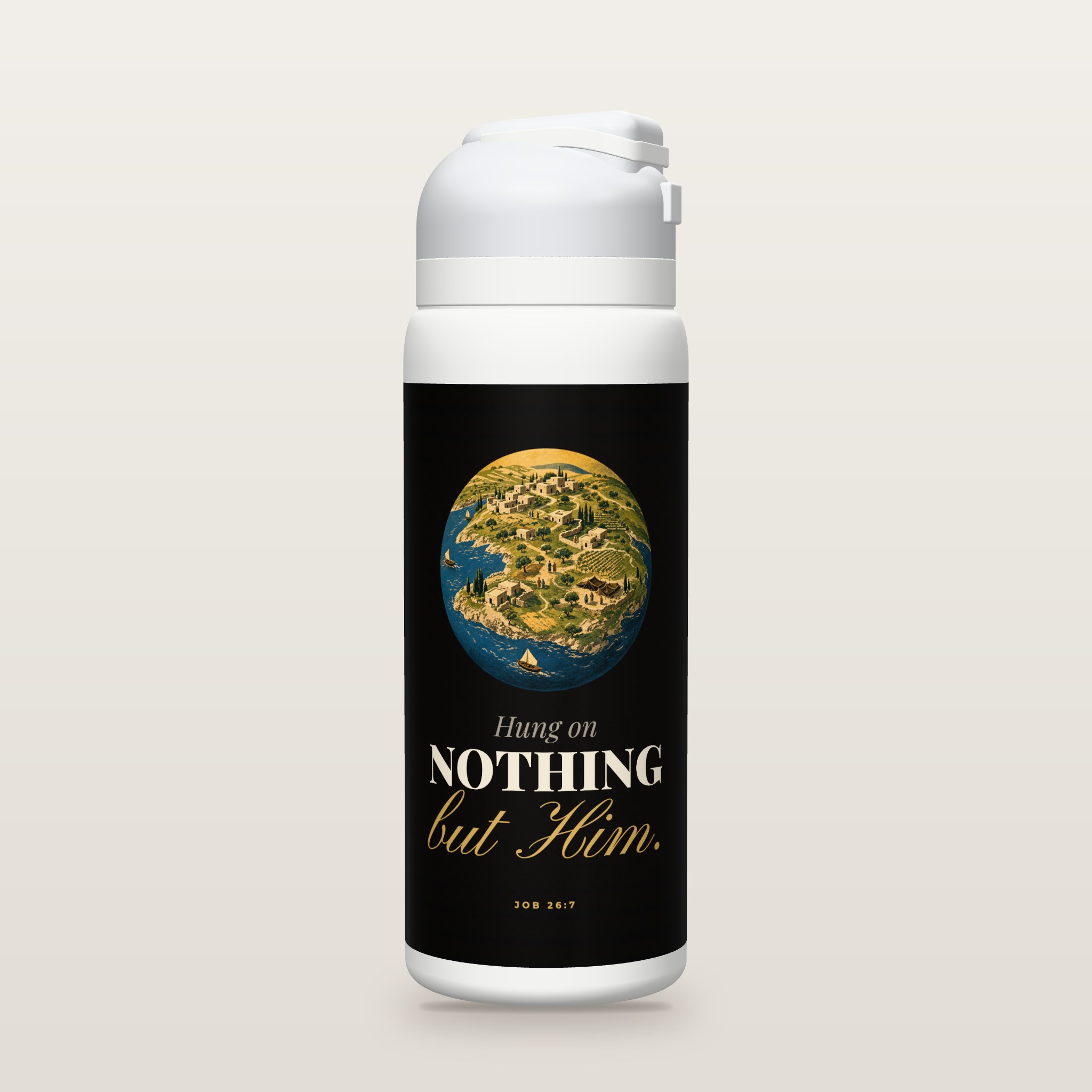
CARRY TODAY’S WORD WITH YOUHung on NOTHING but Him.
He holds what nothing else can.
Explore the October 6 study bottle →