Daily studies that reveal the original Hebrew and Greek meanings behind Scripture. No seminary required — just you, your phone, and 15 minutes.
2 TIMOTHY 4:6 · STRONG’S NUMBER G4689
Paul calls his approaching death an offering. The picture does not erase the suffering; it shows whom his life belongs to, and why faithful service still matters.
“Offered” · spendo · σπένδω
“For I am now ready to be offered, and the time of my departure is at hand.”
2 Timothy 4:6 · King James Version
THE COMPLETE STUDY
Five discoveries, the real app study, and A Morning Offering.


READ · REFLECT · RESPOND

The Greek word is spendo, Strong’s number G4689. It means to pour out a drink offering—a liquid offering given to God. Numbers 28:7 describes a drink offering poured out to the LORD alongside the daily sacrifice. Paul uses this worship picture as he faces the end of his life. He is not simply saying that he feels tired or empty. His life has been spent serving Christ, and he now describes its approaching end as an offering. The word points to devotion; the surrounding passage tells us why that devotion matters here.
2 Timothy 4:6 · Numbers 28:7
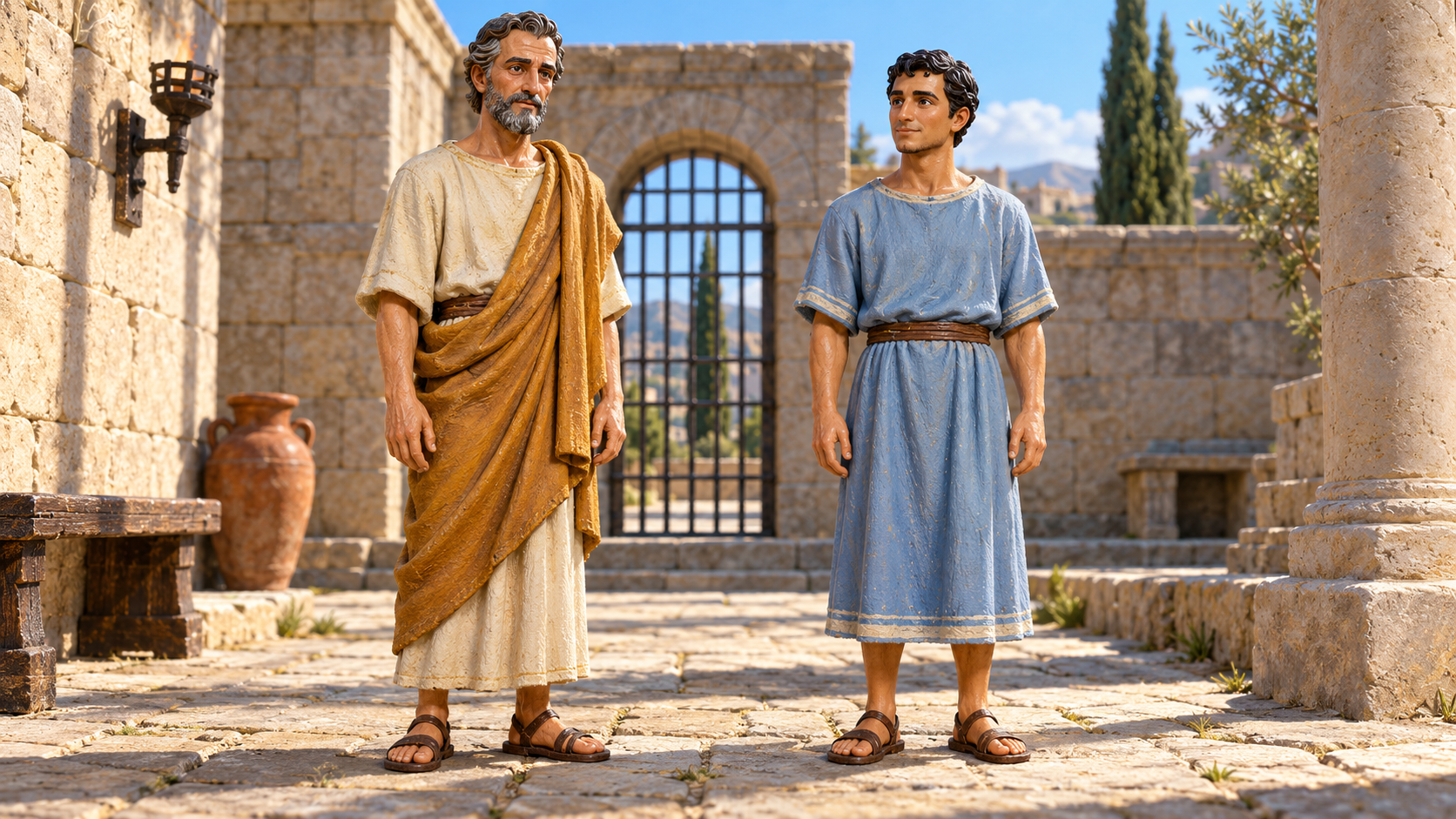
Was Paul’s death something Rome would do to him, or something he offered to God? Those are not competing explanations. The KJV says he is “ready to be offered.” The Greek form describes him as being poured out; it does not say that he controls his execution or causes his own death. The letter also names real opposition and abandonment. Yet Paul says, “the Lord stood with me, and strengthened me.” He entrusts himself to God within those painful circumstances. Faithful devotion does not make injustice good, and this passage does not tell us to seek harm or stay silent about it.
2 Timothy 4:6, 14–18

In Philippians 2:17 Paul had already written, “Yea, and if I be offered upon the sacrifice and service of your faith, I joy, and rejoice with you all.” There, being offered is a possibility. In 2 Timothy, his departure is near. The same picture connects his earlier willingness with his present situation. His final chapter grows out of a life already given to Christ. We do not need to wait for a dramatic moment to practice faithfulness. Keeping a promise, speaking truthfully, and patiently helping someone can give today’s ordinary choices the same direction.
Philippians 2:17 · 2 Timothy 4:6–7

Paul places his possible offering alongside “the sacrifice and service of your faith.” He gives real weight to the Philippian believers’ faith and service, rather than making himself the whole story. He even invites them to share his joy. Earlier in the chapter he tells them to consider others, not only their own interests. Christian service is meant to help people grow in faith and love. It is not a contest to see who can become most exhausted. A faithful response might be a practical meal, a listening ear, or steady encouragement that helps another person keep following Christ.
Philippians 2:3–4, 17–18

Paul says, “I have fought a good fight, I have finished my course, I have kept the faith.” His next words look toward “the Lord, the righteous judge.” An earthly court does not have the final word about his life. His hope is in the Lord, and he includes all who love the Lord’s appearing in that hope. Paul’s offering is not another sacrifice that takes away sin. Hebrews 10:10 points to the offering of Jesus Christ “once for all.” Our service responds to Christ’s finished work. We can keep trusting Him without needing to prove that every hardship has made us successful.
2 Timothy 4:7–8 · Hebrews 10:10
THE BOTTOM LINE
Your life belongs to God even when circumstances are painful. Because Christ has given Himself for us, offer today’s faithful service to Him and help someone else keep going.
READ THE PASSAGES TOGETHER
| Philippians 2:17 | 2 Timothy 4:6–8 |
|---|---|
| “if I be offered” | “I am now ready to be offered” |
| Paul speaks of a possible offering alongside the believers’ faith and service. | Paul says his departure is near and looks back on a life of faithfulness. |
| He shares joy with the church. | He looks ahead to the Lord, the righteous Judge. |
A MOMENT TO RESPOND
Who could be helped by one faithful act of service from you today?
A prayer: Lord Jesus, thank You for giving Yourself for us. Help me offer this day to You, care for another person, and trust You with what I cannot control.
TODAY’S WORD · AN EVERYDAY REMINDER
A companion to today’s study of Offered in 2 Timothy 4:6: a reminder to offer today’s faithful service to God.
360° view · ready to be POURED OUT.
PRINTED ON THE BOTTLE
Every drop given to God.
“For I am now ready to be offered, and the time of my departure is at hand.”
2 Timothy 4:6 · KJV
An everyday reminder to give God the next faithful step.
Explore today’s study bottle ↗


Headline: ready to be POURED OUT.
Verse: “For I am now ready to be offered, and the time of my departure is at hand.”
Meaning: The Greek word means to pour out a drink offering, wine poured beside a sacrifice. Paul doesn’t call his last chapter a defeat. He calls his whole life worship, already being poured out to God.
Reminder: Every drop given to God.
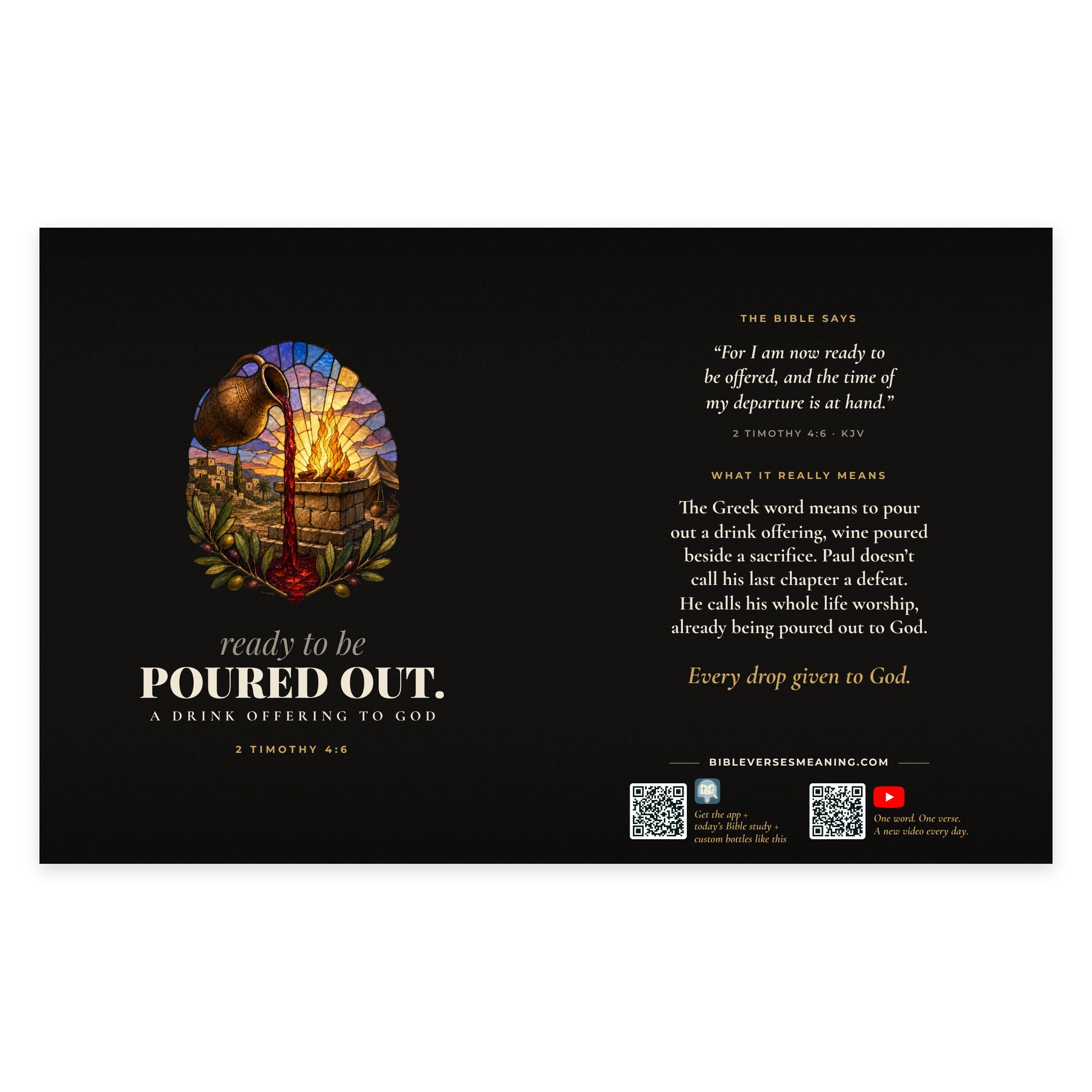
A companion to the study, created to help you remember today’s word.
FROM BIBLE VERSES MEANING
Continue reflecting on the word, the passage, and today’s song.
📖 Word Study: offered (G4689)
2 Timothy 4:6
### 1. Linguistic Nuance
Unlike general sacrificial terms like thyō (to slaughter) or prospherō (to present an offering), spendō (G4689) specifically refers to pouring out a liquid libation. It carries the unique nuance of a final, complete, and deliberate outpouring. Metaphorically, it describes a life entirely expended and given away, rather than a life abruptly or violently taken.
### 2. Historical Context
In both Old Testament Jewish rituals (the nesek or drink offering) and Greco-Roman religious ceremonies, wine was poured at the base of the altar as the final accompanying act of a sacrifice. Timothy and the early church would immediately recognize that Paul viewed his impending execution under Rome not as a tragic defeat or political murder, but as the solemn, worshipful climax of his ministry.
### 3. Practical Application
This concept transforms how we view aging, fatigue, and life's hardships. Instead of seeing our daily energy, time, and inevitable mortality as resources being drained or wasted by circumstances, we can intentionally frame our lives as a conscious act of devotion—choosing to be "poured out" in loving service to God and others rather than holding back.
— Bible Verses Meaning App
💡 Bible Insight
Q: In 2 Timothy 4:6, Paul writes, "I am now ready to be offered (spendo), and the time of my departure is at hand." Is Paul describing his coming death as something Rome is about to do to him, or as a drink offering he himself is pouring out before God? And what does it suggest that he used the same word years earlier in Philippians 2:17, "if I be offered (spendo) upon the sacrifice and service of your faith"?
OVERVIEW
In 2 Timothy 4:6, Paul does not describe his coming death merely as a passive execution inflicted by Rome. Instead, he frames it as a drink offering (spendo) that he actively pours out before God. While human opponents and judicial processes surround his situation 2 Tim 4:14-16, Paul reinterprets his circumstances through the lens of worship, viewing his death as a voluntary act of spiritual devotion.
Years earlier in Philippians 2:17, Paul used the same term to express his willingness to be "offered upon the sacrifice and service of your faith." Using this concept in both letters demonstrates a consistent perspective: Paul viewed his life and suffering not as tragic casualties of political hostility, but as a continuous, deliberate sacrifice. In Philippians, his offering was a prospective addition to the church's faith, whereas in 2 Timothy, that offering reaches its present completion. Across these passages, the scripture teaches that a believer's life and ultimate death are intentional offerings rendered to God rather than mere events dictated by earthly powers.
KEY BIBLICAL PASSAGES
Several key passages demonstrate how this thematic concept develops across Paul's writings:
- Philippians 2:17: "Yea, and if I be offered upon the sacrifice and service of your faith, I joy, and rejoice with you all." In this earlier context, Paul frames his potential martyrdom as a secondary drink offering poured over the primary sacrifice—the faith and obedience of the Philippian believers.
- 2 Timothy 4:6: "For I am now ready to be offered, and the time of my departure is at hand." Here, what was previously a conditional possibility ("if I be offered") becomes an immediate, present reality as Paul prepares for the end of his earthly life.
- 2 Timothy 4:7-8: "I have fought a good fight, I have finished my course, I have kept the faith: Henceforth there is laid up for me a crown of righteousness..." Paul connects his self-offering to a completed athletic race, looking past earthly judges to "the Lord, the righteous judge."
- Philippians 2:5-8: Christ Jesus "humbled himself, and became obedient unto death, even the death of the cross." Paul's view of his life as an offering reflects the foundational example of Christ's voluntary self-emptying and obedience.
PRACTICAL WISDOM
The principle of viewing one's life as a drink offering provides clear guidance for handling personal trials and daily responsibilities:
First, it changes how individuals interpret hardship. Rather than viewing suffering or unfair treatment strictly as damage inflicted by external circumstances or people, one can choose to view patient endurance as an active, worshipful offering to God 2 Tim 4:5.
Second, it shapes personal priorities toward mutual service. Just as Paul viewed his sacrifice as supporting the faith of others Phil 2:17, individuals are challenged to look beyond personal self-preservation and invest in the spiritual growth and well-being of their community Phil 2:3-4.
Finally, it encourages a long-term focus on personal integrity over immediate comfort. By viewing daily decisions as part of running a continuous race 2 Tim 4:7, individuals can maintain faithfulness through difficult seasons, finding joy in pouring out their energy for a purpose greater than themselves.
— Bible Verses Meaning App
A Morning Offering uses the cup and pouring-out imagery to reflect on willing devotion. Its words are poetic reflections, not a quotation or a full explanation of Paul’s circumstances. In 2 Timothy 4, Paul still faces real opposition and an approaching death he does not control. The song’s “perfect sacrifice” language must be heard in light of Christ’s once-for-all offering; Paul’s service and ours do not replace it. The complete creator-supplied lyrics are preserved, with audible repetitions retained in the timed captions.
(Mmm...)
(Pouring out...)
The cup is steady in my open hands
Not taken by a force or shifting sands
I choose the moment when the seal breaks free
A final act of what was meant for me
No sudden shadow, no heavy, violent cost
Just everything I held is finally lost
I'm offered, I'm poured out
Leaving behind every trace of doubt
A liquid life, given to the light
The dawn has finally broken the night
Offered, poured out to the flame
Calling out a new, eternal name
It's not the breaking of a vessel's rim
But filling up the cup right to the brim
I lean into the stillness of the air
A quiet answer to a silent prayer
The essence of the journey is revealed
In every drop the promise has been sealed
I'm offered, I'm poured out
Leaving behind every trace of doubt
A liquid life, given to the light
The dawn has finally broken the night
Offered, poured out to the flame
Calling out a new, eternal name
Not held back, not kept away
I'm giving all of me today
From the spirit to the ground
The perfect sacrifice is finally found
(Oh, let it pour...)
I'm offered, I'm poured out
Leaving behind every trace of doubt
A liquid life, given to the light
The dawn has finally broken the night
Offered, poured out to the flame
Calling out a new, eternal name
Just pouring...
Completely spent...
Offered.
(Mmm, peaceful now...)
Try Bible Verses Meaning free for 7 days and discover what the original words really mean.
