Daily studies that reveal the original Hebrew and Greek meanings behind Scripture. No seminary required — just you, your phone, and 15 minutes.
TITUS 3:4 · STRONG’S NUMBER G5363
Paul describes God’s kindness becoming visible in mercy. Luke uses the same Greek word for islanders who welcomed shipwrecked strangers out of the rain. Together, the passages help us recognize love that acts.
“Love toward man” · philanthropia · φιλανθρωπία
“But after that the kindness and love of God our Saviour toward man appeared,”
Titus 3:4 · King James Version
THE COMPLETE STUDY
Five discoveries, the real app study, and Grace In The Rain.


READ · REFLECT · RESPOND

Paul is writing to Titus, a fellow worker helping believers learn how to live. He first recalls their former foolishness, disobedience, and hatred. Then the words “But after that” introduce a change: God’s kindness appeared, and He saved them. The Greek word behind love toward man is philanthropia, Strong’s number G5363. It means kindness or goodwill toward people. The word does not by itself explain the whole story of salvation; the next verses do. God saved according to His mercy and poured out the Holy Ghost through Jesus Christ. His love did not begin when it appeared. His merciful character became visible in this saving action. We are being shown what God did, not asked to imagine a distant warmth that never reaches anyone.
Titus 3:3–6

Paul says, “Not by works of righteousness which we have done, but according to his mercy he saved us.” These words place the reason for salvation in God’s mercy, not in a record of good behavior. Paul goes on to describe new life and renewal by the Holy Ghost. Being “justified by his grace” means being put right with God by His undeserved favor. This is more than being told to feel better about ourselves. God acts to renew people who need His help. When guilt makes us think we must become worthy before turning to Him, this passage points us back to mercy. Good actions matter, but they cannot become the price we offer for this rescue.
Titus 3:5–7

After a shipwreck, Paul and his companions reached Melita, the island now called Malta. Luke says the islanders showed “no little kindness.” That is another use of philanthropia, Strong’s number G5363. They made a fire and welcomed everyone because it was raining and cold. The KJV calls them “barbarous people,” a term here for people who did not speak Greek, not a claim that their welcome was cruel. The shared word helps us see kindness in a concrete act. A warm fire meets a wet traveler’s need. The islanders’ hospitality is not the same event as God’s saving work, but both passages show goodwill reaching people through help they can receive.
Acts 28:1–2

Before speaking about salvation, Paul tells believers to be gentle and show meekness to everyone. Meekness means humility expressed in how we treat people; it is not permission to harm them or ignore wrongdoing. He reminds his readers that they too had lived foolishly. Remembering our own need for mercy challenges the habit of looking down on someone else. Acts adds a welcome from people outside Paul’s own community. They received the whole shipwrecked company. We can recognize real kindness across cultural differences and offer it without first asking whether someone belongs to our circle. That may mean listening without ridicule, making room for a newcomer, or helping a neighbor whose beliefs differ from ours.
Titus 3:2–3 · Acts 28:2

The chapter does not end with permission to do nothing. Paul calls those who have believed in God to maintain good works, and he connects those works with necessary needs. Grace is God’s undeserved favor; good works are a response to it, not a way to buy it. Ask what would actually help a person in front of you. A meal, a ride, a practical task, or patient company may be more useful than a polished speech. The right action depends on the real need and what you can responsibly offer. We do not become anyone’s savior by helping. We pass along a small, concrete expression of the kindness we have received.
Titus 3:8, 14
THE BOTTOM LINE
God’s love toward people became visible in His merciful rescue through Jesus Christ. We receive that mercy as a gift, then respond with humble, useful care for others.
READ THE PASSAGES TOGETHER
| Titus 3:4–7 | Acts 28:1–2 |
|---|---|
| God’s love toward people appears. | Islanders welcome shipwrecked strangers. |
| He saves according to His mercy. | They light a fire against the rain and cold. |
| Grace is the source of rescue. | Practical hospitality meets an urgent need. |
The same Greek word describes goodwill toward people. The surrounding verses tell us what that kindness does in each setting.
A MOMENT TO RESPOND
Who near you needs useful care, and what can you responsibly offer?
A prayer: Lord, thank You for saving according to Your mercy. Give me a humble heart and help me make Your kindness visible in how I treat someone today.
TODAY’S WORD · AN EVERYDAY REMINDER
A companion to today’s study of Love toward man in Titus 3:4: a reminder of God’s mercy and kindness made visible.
360° view · Love toward man APPEARED.
PRINTED ON THE BOTTLE
Not a donation. A rescue.
“But after that the kindness and love of God our Saviour toward man appeared…”
Titus 3:4 · KJV
An everyday reminder to receive His mercy and offer useful care.
Explore today’s study bottle ↗


Headline: Love toward man APPEARED.
Verse: “But after that the kindness and love of God our Saviour toward man appeared…”
Meaning: Our word “philanthropy” comes from this Greek word: “love toward man.” Luke uses it for islanders who lit a fire for shipwrecked strangers. Paul uses it of God, who came Himself to rescue us.
Reminder: Not a donation. A rescue.
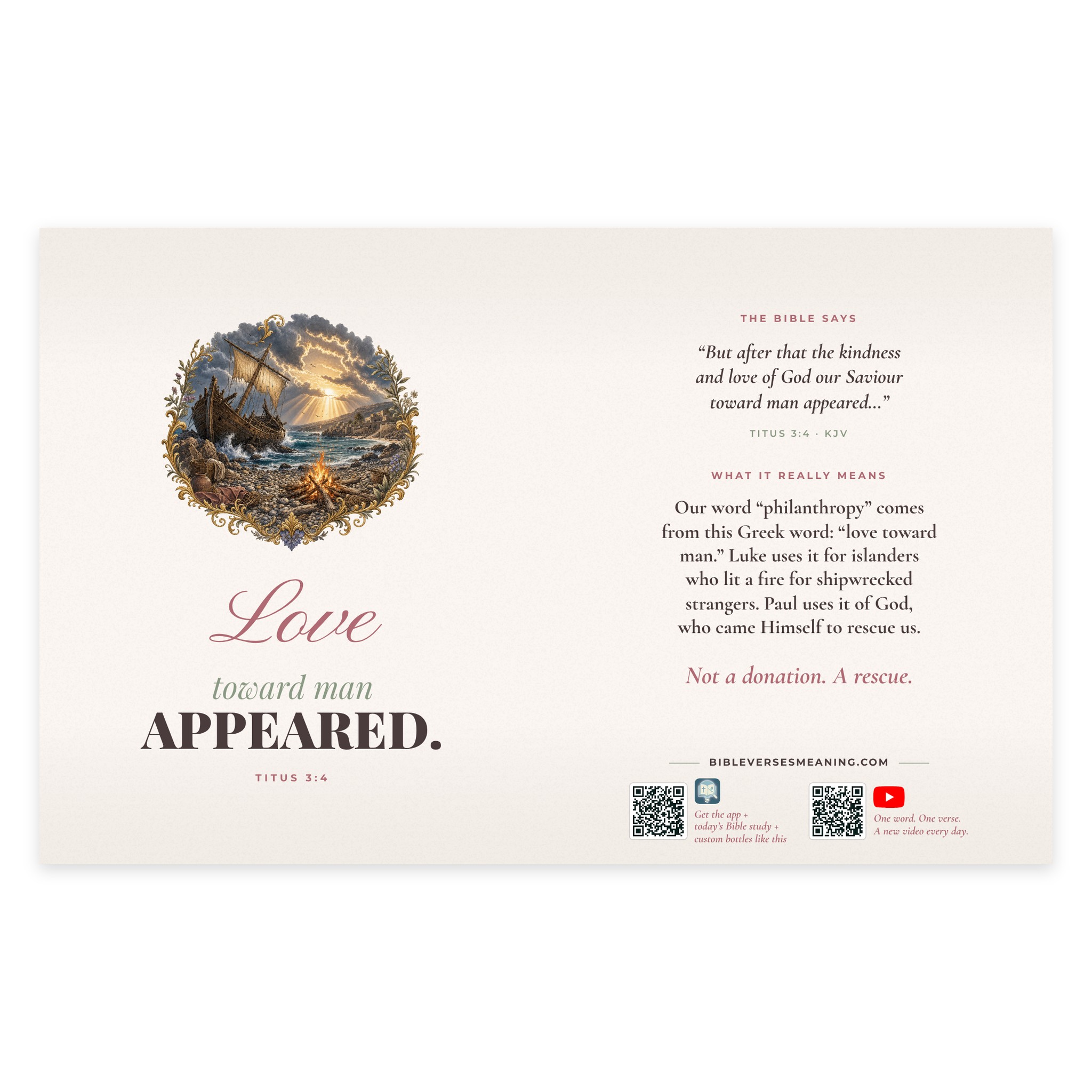
A companion to the study, created to help you remember today’s word.
FROM BIBLE VERSES MEANING
Continue reflecting on the word, the passage, and today’s song.
📖 Word Study: love (G5363)
Titus 3:4
1. Linguistic Nuance
The Greek word philanthropia (combining philos, "affectionate friend," and anthropos, "humanity") differs from agape (sacrificial, volitional love) and phileo (reciprocal affection). Unlike agape, which emphasizes the act of the will, philanthropia highlights a warm, inherent, and friendly posture specifically toward the human race. It is divine favor expressed as warmth toward mankind.
2. Historical Context
In the Greco-Roman world, philanthropia described the ideal virtue of a sovereign deity or emperor who generously rescued subjects or bestowed civic favors. Paul’s audience would understand God not as a distant, vengeful monarch, but as the supreme ruler whose saving act in Christ was a grand display of royal benevolence toward helpless citizens, unearned by human merit (Titus 3:5).
3. Practical Application
Because God’s love is framed as goodwill toward humanity, modern readers are called to embody this same non-discriminatory benevolence. It challenges believers to move beyond insular religious circles and show tangible kindness, dignity, and active humanitarian concern to all people, mirroring God’s affectionate posture toward the world.
— Bible Verses Meaning App
💡 Bible Insight
Q: In Titus 3:4, Paul writes, "the kindness and love of God our Saviour toward man (philanthropia) appeared." Is this love toward man a general goodwill God has always held for the human race, or a specific rescue that only became visible when Christ appeared? And what does it suggest that Luke uses the same word in Acts 28:2, where the "barbarous people" of Melita "shewed us no little kindness (philanthropia)" to shipwrecked Paul?
OVERVIEW
In Titus 3:4, God’s "love toward man" (philanthropia) describes a divine benevolence that specifically manifested as an act of rescue. While reflecting God's merciful character, this kindness was made visible at a distinct moment in human history through Jesus Christ Titus 3:6 to save individuals out of a state of foolishness, disobedience, and mutual hatred Titus 3:3-5.
In Acts 28:2, Luke uses the exact same word (philanthropia) to recount how the "barbarous people" of Melita showed "no little kindness" to Paul and his fellow shipwrecked travelers by kindling a fire and welcoming them out of the freezing rain and cold.
Comparing these passages reveals a consistent biblical definition: philanthropia is not merely an abstract feeling of goodwill, but a practical, active intervention to rescue vulnerable people from suffering or distress. Just as the islanders offered physical warmth and safety to stranded strangers, God’s philanthropia appeared as a concrete action to deliver helpless humanity.
KEY BIBLICAL PASSAGESIn Titus 3:3-5, Paul contrasts humanity's former condition—living in "malice and envy, hateful, and hating one another" Titus 3:3—with the revelation of divine mercy. Paul explains that "after that the kindness and love of God our Saviour toward man appeared," He saved believers "not by works of righteousness which we have done, but according to his mercy, by the washing of regeneration, and renewing of the Holy Ghost" Titus 3:4-5. Here, philanthropia refers to God's unmerited, historical rescue of sinners.
In Acts 28:2, Luke applies the word to human hospitality: "And the barbarous people shewed us no little kindness: for they kindled a fire, and received us every one, because of the present rain, and because of the cold." The account continues as Publius lodges the crew courteously and Paul prays for and heals the sick on the island Acts 28:7-9.
Together, these passages demonstrate that biblical philanthropia involves compassionate action directed toward people in need. Whether shown by non-Greek islanders relieving physical distress Acts 28:2 or by God granting eternal salvation Titus 3:4-5, the term highlights unsolicited mercy meeting immediate helplessness.
PRACTICAL WISDOM
The scriptural use of philanthropia provides clear guidance for daily Christian living and ethical conduct:
First, divine kindness serves as the model for human relationships. Because believers received unmerited mercy when they were rebellious Titus 3:3-5, the text instructs them to "speak evil of no man," to be "gentle, shewing all meekness unto all men" Titus 3:2, and to be "careful to maintain good works" Titus 3:8.
Second, Acts 28:2 shows that true kindness requires practical action rather than empty well-wishing. In daily life, this means providing tangible help to those in urgent need—such as offering shelter, resources, or comfort to strangers facing hardship—regardless of cultural or social barriers.
Finally, recognizing that salvation stems entirely from God's mercy rather than personal merit eliminates self-righteousness. The text encourages believers to actively look for opportunities to serve others and "learn to maintain good works for necessary uses" Titus 3:14, ensuring that their faith produces tangible, beneficial fruit in their communities.
— Bible Verses Meaning App
Grace In The Rain celebrates unearned love and the warmth of welcome, connecting Titus 3:4–5 with the rain and fire of Acts 28:2. Its first-person images are a poetic response, not a quotation or a new definition of the Greek word. The language about rules and earning is read alongside Titus 3:8 and 14: good works do not purchase salvation, but those who receive mercy are called to useful care. The song’s healing language expresses praise; it is not a promise of immediate physical healing for every listener.
Mmm, mm, yeah. (Mmm, mm...) Hear the heartbeat now. Oh, yeah...
I looked for cold, iron rules. Expecting chains from sovereign fools. I thought the master demanded pain. Leaving my soul out in rain. But I found a smiling face. An open hand, a warm embrace. A friendly posture, purely given. Pulling me straight into heaven.
Oh, I am loved! (Yes, I am!) With a warm heart. No more distance now! Healed and made whole! Oh, I am loved! Inherent, friendly grace. Look at His face!
No hollow laws to keep me. His eyes are shining so sweetly. It ain't about what I earned. A lesson so beautifully learned. The sovereign is a true friend. With kindness that has no end. No more running in the dark. He put a light in heart.
Oh, I am loved! (He called me friend!) With a warm heart. No more distance now! Healed and made whole! Oh, I am loved! Inherent, friendly grace. Look at His face!
Oh, I am loved! (Can't nobody tell me!) With a warm heart. No more distance now! Healed and made whole! Oh, I am loved! Inherent, friendly grace. Look at His face!
Yeah... purely given... (Mmm, warm heart.) Oh, so loved. (Loved...)
Try Bible Verses Meaning free for 7 days and discover what the original words really mean.
